Architecture Overview
AnomaPay decouples the simple intent to move funds from the execution of that movement. This architecture allows users to interact with the blockchain without needing high-performance hardware for zero-knowledge proof generation or needing to manage gas manually.
The Transaction Lifecycle
When you use AnomaPay, the flow of data looks different than a standard EVM transaction.
Here is the step-by-step lifecycle of a private transfer:
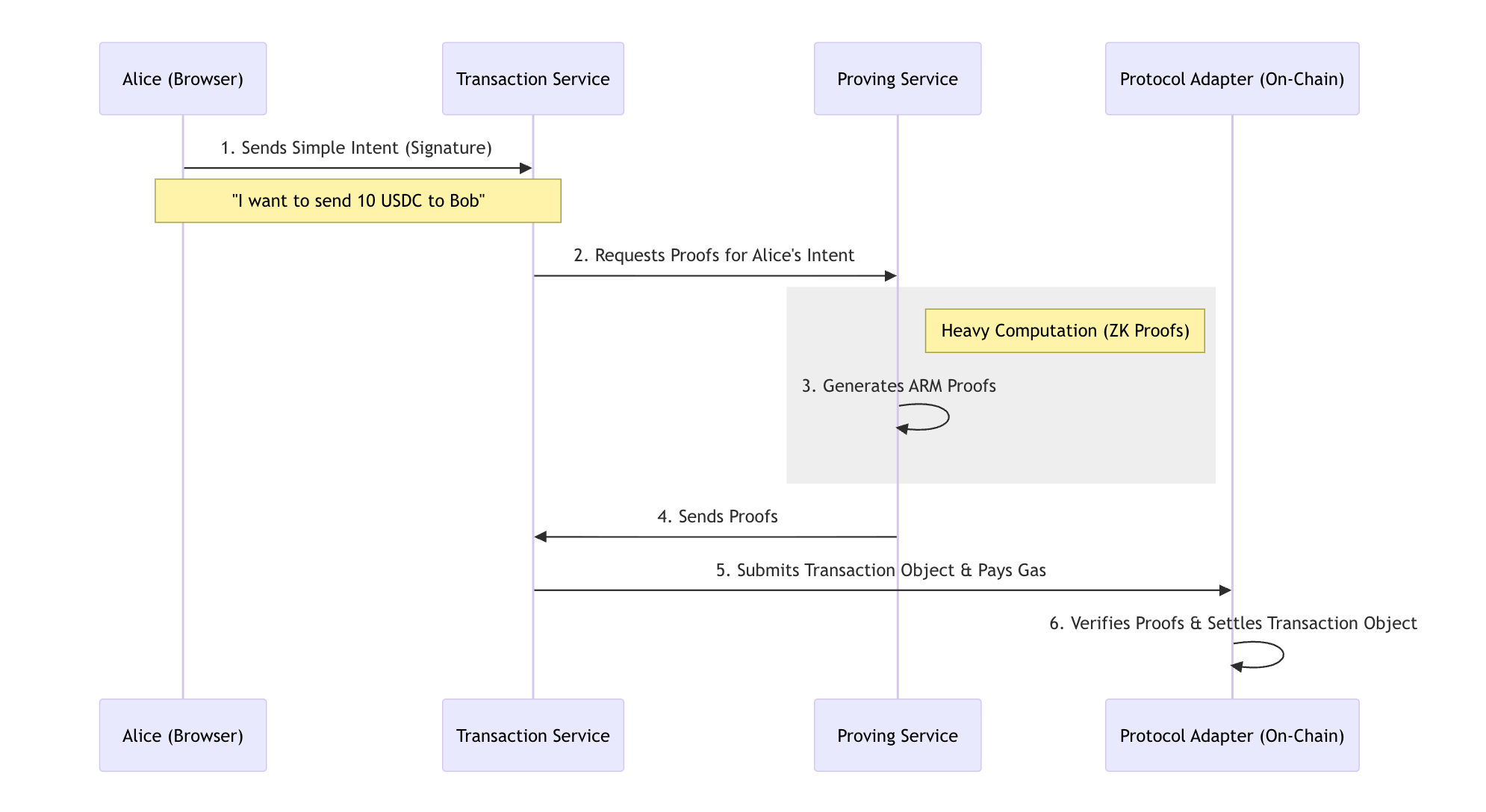
The User Intent (Alice)
The process begins with Alice (the User). She interacts with the AnomaPay frontend to create a payment Intent — a simple instruction like “I want to send 10 USDC to Bob.”
- Alice signs this intent using her in-browser wallet or passkey.
- She then sends this signed intent directly to the Transaction Service. She does not need to communicate with the Prover directly.
The Transaction Service Orchestration
The Transaction Service acts as the coordinator. It receives Alice’s simple intent and uses it to craft the appropriate transaction to be executed on-chain.
- The Transaction Service applies checks before and after proving to ensure that the final Transaction Object will be able to execute and settle on-chain.
- The Transaction Service forwards the request to the Proving Service, asking for the necessary proofs to validate Alice’s intent.
- It packages these into a Transaction Object.
The Proving Service
This is where the heavy lifting happens. The Proving Service receives the request from the Transaction Service.
- It performs the computationally intensive work to generate Anoma Resource Machine Proofs.
- These Zero-Knowledge Proofs attest that Alice has the funds and permission to spend them, without revealing her private key or history.
- Once complete, the Proving Service sends these proofs back to the Relayer.
The Protocol Adapter
The Protocol Adapter enables Anoma Resource Machine transactions to settle on EVM- compatible chains via its execute() function.
- The Transaction Service submits this object to the Protocol Adapter on the blockchain, paying the necessary ETH gas fees.
- The Protocol Adapter contract verifies the proofs via the respective Risc0 verifier contract and settles the transaction, updating the balances for Alice and Bob securely.
WHY THIS MATTERS
This architecture provides Hardware Abstraction and Gas Abstraction. You don’t need a powerful GPU to generate proofs, and you don’t need ETH in your wallet to pay for gas —the services handle this for you.